
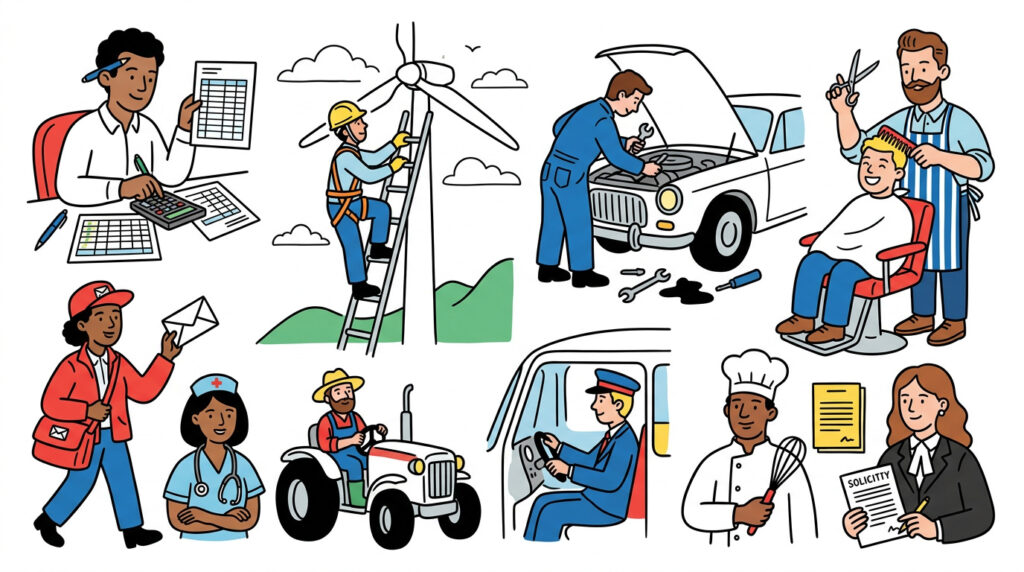
Exploring careers and developing skills
Choosing your next steps can feel overwhelming, but it doesn’t have to. This section brings together simple tools, clear guidance, and up‑to‑date information to help you understand your options and feel confident about your future.
From exploring growing job areas to building your CV, preparing for interviews, and understanding what employers are looking for, you’ll find everything you need to get started.

*West Suffolk College courses coming soon
Click each of the below to expand and read more.
What is Labour Market Information (LMI)?
Labour Market Information (LMI) is reliable, up‑to‑date insight into the world of work. It helps you understand:
- Which industries are growing (like digital, green skills, and health)
- What skills employers need
- What jobs exist locally and nationally
- Typical pay and future opportunities
LMI makes the careers world clearer, helping students and parents make informed decisions about subjects, courses, and next steps.
Useful tools
- SACU – job trends, pay info, future demand
- Careerometer – compare different jobs quickly
- Skillsometer – explore careers based on your interests
- Youth Employment UK LMI Guide – easy explanations designed for young people
Labour Market Information Hub at Eastern Education Group
We have also made our own EMSI‑powered LMI Dashboard, which uses real job postings and local data to show what employers in our region need right now.
The dashboard includes five easy‑to‑use reports:
1. Skill Overview by Career Area
See the key skills needed for different types of jobs and how many people work in those roles locally.
2. Sector Overview
Explore an entire industry — including growth areas and major employers in our region.
3. Job Postings by Occupation
Find out which specific job roles are being advertised now and where opportunities are located.
4. Job Postings by Skills
See the skills employers are asking for most often in current job adverts.
5. Industry Growth and Concentration
Discover which industries are expected to grow in the future and where they are strongest across the country.
Growing sectors
The world of work is changing quickly. New technology, environmental challenges, and global connections are creating exciting opportunities in a range of industries. Three areas with strong future demand are green careers, digital careers, and global careers.
Green Careers
Green careers focus on protecting the environment and helping communities live more sustainably. As countries work to reduce carbon emissions and protect natural resources, the demand for people with green skills is increasing.
Examples of green careers include:
- Renewable energy engineers
- Environmental scientists
- Sustainability consultants
- Conservation officers
- Electric vehicle technicians
These roles help develop clean energy, reduce waste, protect wildlife, and create sustainable businesses.
Digital Careers
Digital careers involve using technology to solve problems, create products, and improve services. Almost every industry now relies on digital skills, meaning there are many opportunities for people interested in technology.
Examples of digital careers include:
- Software developers
- Data analysts
- Cybersecurity specialists
- Digital marketers
- UX/UI designers
- AI engineers
Digital careers often offer flexible working opportunities and are among the fastest-growing job areas worldwide.
Global Careers
Global careers involve working across countries, cultures, and international markets. As businesses expand internationally and communication becomes easier, people who understand global systems and cultures are increasingly valuable.
Examples of global careers include:
- International business managers
- Supply chain specialists
- International relations advisors
- Translators and interpreters
- Global project managers
These roles often involve collaboration with people from different parts of the world and may include travel or international partnerships.
Developing skills such asproblem-solving, communication, digital literacy, andadaptability can help you succeed in these growing career areas. Education, training, and work experience can also help build the knowledge needed for these future-focused roles.
Employment support resources
CVs and Covering Letters
Whether you’re seeking work experience or employment and apprenticeship opportunities it’s important to have a well written CV and cover letter
Why is this so important?
In the labour market of today almost every time you apply for a job you will be asked for a CV and in some cases a covering letter as well even if the vacancy doesn’t request it, it is considered standard practice. Employers often require specific details and skills; your CV acts as a crucial marketing tool for your personal branding and outlines of your abilities and experience. The cover letter is the first impression an employer has of you– it should be an introduction that briefly covers your interest in the role and sells your suitability.
What is the difference between a CV and a cover letter?
There is often confusion between these two documents, so it is helpful to understand what the individual purposes are:-
A CV is a marketing tool in which you can present your skills, qualifications and experiences to potential employers providing an opportunity to make a good first impression and show what benefits hiring you will bring to their team. There are no strict rules for writing a CV but it should be concise, well-structured, and summarise your own unique skills, character, experience and achievements. CV writing etiquette changes over time, so it’s important to keep updating your CV and tailored to each job that you apply for.
A Cover Letter is an important part of an application, whether this is for an advertised vacancy or if you are enquiring speculatively about the possibility of gaining employment. Cover letters can be personalised not just to the role or to the company to which you are applying but also to the hiring manager. This shows any potential employer that you have researched and are genuinely interested in the role, or in the case of an enquiring letter that you have motivation.
The cover letter enables you to introduce yourself and show more of your personality. It can also help to showcase specific skills that you want to draw attention to on your CV and is especially useful if you don’t have all the required skills being asked for in the advert as you can provide details of how you would adapt what you have achieved to for the role. It can also help explain any gaps in employment you may have had for varying periods. This could be through returning to education and training to changes in your personal life, moving locations, career breaks to raise a family for example.
Things to remember when writing your CV
You need to tailor your CV!
The most effective CVs are tailored to the specific role and organisation that you’re applying to. This ensures that the recruiter or employer reading it can easily imagine you in that role. When it comes to CVs, one size does not fit all.
There are some important points to remember when creating a CV
- Don’t lie – Employers often run background checks and false claims will be uncovered
- Sell yourself – What are your unique qualities, personality traits, skills and experience that make you stand out from the crowd
- Personal statement first – Put your academic qualifications at the back, if you’re buying a new car would you want to see the technical spec or the glossy picture first?
- Don’t leave unexplained gaps – If you had a career break to travel or raise a family, explain what skills or experience you gained from this
- Be clear and concise – CVs should be a maximum of three pages long and should be easy to read
- Don’t make mistakes – Check your spelling and grammar meticulously.
Before you start
Find out as much as you can about the job role you are applying for and highlight key points to cover; The job description or person specification will usually detail these:
- Required qualifications
- Required or desired skills & knowledge
- Any experience requirements
- If you are making a speculative application where this is not possible, refer to the job profiles on the Prospects website www.prospects.ac.uk/job-profiles or the National Careers Service Careers advice – job profiles, information and resources | National Careers Service
This will give you an idea of the general skills or requirements for various job roles.
Remember – all experience counts. Many roles will give you skills that can transfer to many different roles. Use these to your advantage
Deciding on a CV style
Chronological (or Reverse Chronological)/Traditional
This format is also known as a Traditional CV and is a style that goes through each section in reverse chronological order meaning putting your most recent qualifications and job roles first to give them more focus and attention.
This style of CV is useful to demonstrate a variety of experience, it is easy to understand and highlights your career progression over the years.
Skills Based
A specialised style of CV which focuses on the specific skills employers are looking for, using skills as headings to demonstrate your relevant experience.
You will need to match skill headings to those the employer is looking for. The skills section fills at least your first page, and the remainder of your CV can be used to briefly explain your education and employment dates and descriptions.
This style of CV is useful when applying for positions, not directly linked to previous job roles. In most cases, a reverse chronological CV is preferable for a student or graduate
Cover Letters
The more you target and tailor your letter to a role and employer, the more likely it is to stand out – just like your CV, you will need to make a new one for each role you apply for. Unlike a CV, however, a cover letter has more room to show your personality and tell the story of your career journey.
- First impressions matter
- This is your chance to show an employer:
- Your main selling points
- How relevant your skills are to the position
- How interested you are in the position
- How much you know about the company
Addressing your letter
Address your letter to a named individual within the company to ensure that it is read by the correct person. If you do not have a named individual, research the website to find a contact or get in touch the HR department.
If you are given someone’s full name, e.g. Joe Bloggs, do not address the letter ‘Dear Joe’ unless you are very familiar with the person. Start with ‘Dear Mr Bloggs’.
If you find it impossible to get the name of an individual within the company, use one of the following titles: Recruitment manager’ HR Manager’ or ‘ Recruitment team’.
If you have a named contact – you should conclude
‘Yours sincerely’.” If not – conclude with “Yours faithfully”
Other tips: style, formatting and more
If you are submitting your letter on paper, ensure the paper you use is good quality.
- Your letter should come close to filling one A4 page.
- Keep fonts and text styling consistent with your CV.
- Email will give you less control over fonts and layout but treat the body of your email carefully – use the subject line to give your name and the job role you are applying for, and remain formal.
- Don’t forget to attach your CV, make sure that it has loaded into the email. Also make note that your CV is attached, so the employer is alerted that something has gone wrong if it is not present.
Further advice on CV writing, cover letters and Interview skills can be found on the Job Shop page: Getting ready to enter the workforce where you will find resources to support you including a CV Building Tool which is helpful for drafting your first CV.
Digital footprint advice
Your digital footprint is the record of information about you that exists online. This includes social media posts, photos, comments, online profiles, and anything else connected to your name on the internet.
Employers, universities, and organisations may sometimes look at online information about candidates, so it’s important to manage your digital presence carefully.
Managing your Digital Footprint:
Think before you post.
Anything you share online can potentially be seen by others and may remain online for a long time.
Before posting, consider:
- Would I be comfortable if a teacher, employer, or family member saw this?
- Does this post reflect me in a positive way?
- Could this be misunderstood out of context?
Taking a moment to think before posting can help protect your online reputation.
Check your privacy settings
Most social media platforms allow you to control who can see your content.
You can:
- Set profiles to private
- Limit who can view your posts and photos
- Control who can tag you in posts
- Review past posts and remove anything you no longer want online
Regularly checking your privacy settings helps you stay in control of your digital footprint.
Be positive and professional
Your online presence can also work in your favour- it promotes you!
You can build a positive digital footprint by:
- Sharing achievements or projects
- Participating in positive online discussions
- Creating professional profiles
- Demonstrating your interests and skills
This can help show employers or education providers what you are passionate about.
Staying safe online
Protecting your personal information is also important.
Avoid sharing:
- Your home address
- Phone numbers
- Passwords
- Financial information
Being careful about what you share helps keep you safe online.
Checking up on you
It can be helpful to occasionally search your own name online to see what information appears. This helps you understand what others might find when they look you up.
If you find something you don’t like, you may be able to:
- Delete the content
- Change privacy settings
- Ask the person who posted it to remove it
Your digital footprint is part of your personal brand. Managing it carefully can help you create positive opportunities for education, employment, and networking. Professional websites such as LinkedIn support this – How to stand out on LinkedIn | National Careers Service
Interview preparation
Great news — you’ve got an interview!
Now it’s time to get ready so you can walk in (or log in!) feeling confident, informed, and prepared.
1. First steps: check the interview details
Before you dive into preparation, make sure you know exactly what to expect:
- Doublecheck the date and time.
- Confirm whether the interview is in person, over the phone, or online.
- Make a note of any instructions they’ve sent – location, login links, or required documents.
2. Getting prepared
A strong interview starts long before the day itself. Here’s how to set yourself up for success:
- If you need them, request reasonable adjustments to help you perform at your best.
Asking for adjustments at interview | Disability charity Scope UK - Read the job description carefully and think about how your skills and experiences match what they’re looking for.
- Spend time exploring the organisation’s website, getting familiar with their mission, values, and any recent updates.
- Look over your CV or application, so you’re ready to expand on anything they may ask about.
- If you’re attending in person, practice the route so you know where you’re going and how long it takes.
- Prepare several examples from your experience using the STAR technique.
- Make sure you have any required right to work documents ready.
3. What happens in an interview
Although every interview is slightly different, most follow a similar pattern:
- You’ll start with introductions- this may include a brief handshake, and an outline of how the interview will run.
- Expect an early question about what you know about the organisation or role (your research pays off here!).
- Next, they’ll move into structured questions about your experience and skills.
- Toward the end, you’ll usually be invited to ask your own questions- aim to have three or four prepared.
- For video interviews, choose a clear or blurred background, and feel free to place short notes on post-it notes where you can see them without breaking eye contact too often.
4. Common interview questions
i) “Tell me about yourself”
- Start with your current role- include responsibilities and key achievements.
- Add a brief overview of previous experience and relevant education.
- Share why this opportunity interests you and how it fits with your future goals.
- Keep it focused on what’s most relevant to the job.
ii) “Why do you want this job?”
- Choose 2–3 reasons directly linked to the role or organisation.
- Explain how these connect with your strengths, interests, or long-term goals.
iii) “What is your greatest weakness?”
- Pick a real, manageable weakness.
- Explain what you’re doing to improve and show evidence of progress.
- (And yes — avoid “I’m a perfectionist”!)
Common interview questions and answers | reed.co.uk
5. The STAR technique
A simple structure that helps you answer competency questions clearly:
- Situation — What was happening?
- Task — What needed to be done?
- Action — What you did.
- Result — What happened and what you learned.
How to use the STAR interview technique — Indeed:
https://uk.indeed.com/career-advice/interviewing/star-technique
6. On the day
- Give yourself plenty of time to arrive.
- Turn off your phone.
- Test your tech if it’s an online interview.
- Aim to be ready 5–10 minutes before the start time.
7. Questions to ask the interviewer
Having questions ready shows interest and enthusiasm. You could ask:
- “What does a typical day as a _______ look like?”
- “What opportunities are there for training and development?”
- “Can you tell me more about the team I’d be joining?”
- “What are the next steps, and when can I expect to hear from you?”
7 good questions to ask at an interview | Prospects.ac.uk
8. After the interview
Send a short thankyou email, showing appreciation and reaffirming your interest.
9. If you’re unsuccessful this time
- Ask for feedback to support your development.
- Reflect on what went well — and what could be improved for next time.
- Remember: it’s normal to have several interviews before receiving an offer.
Good Luck!
You’ve done the prep, now go in and shine
Employability skills
What Are Employability Skills?
Employability skills are the blend of soft skills, personal qualities, and transferable abilities. These skills are valuable across all industries and help students adapt, communicate, solve problems, and work well with others.
1. Communication
Communication skills are essential in almost every job. You use them when you:
- write emails
- deal with customers
- listen to others
How to Improve Your Communication
You can strengthen communication skills by speaking with new people and practising in real situations. For example, you could:
- work on non-verbal communication such as eye contact and body language
- volunteer in a role that involves speaking to the public
- practise making phone or video calls
- Ask questions when you are on a trip or have a visiting speaker
2. Teamwork
Teamwork skills help you collaborate effectively and contribute positively to group goals. You use teamwork when you:
- work towards shared targets
- interact with other students, teachers, lecturers and other members of staff on a shared project
- Belong to a sports team or group where you are working towards the same goal
How to improve your teamwork
You can build teamwork skills by:
- joining a team, club, or creative activity
- taking part in team‑building exercises
- improving your communication when undertaking group work in the classroom
3. Positivity
Employers value people who stay optimistic and look for solutions rather than problems. Positivity shows up when you:
- remain calm in stressful situations
- look for constructive ways to overcome challenges
- show a proactive, “can-do” attitude
How to improve your positivity
You can improve your positivity by:
- practising problem solving when things go wrong
- Having a Plan B or a back-up plan
- reframing negative thoughts into more balanced ones
4. Flexibility
Being flexible demonstrates that you can adapt quickly and manage change with confidence. You might show flexibility by:
- covering for a colleague in your part time job
- working outside your usual hours
- switching tasks based on changing priorities
How to improve your flexibility
You can develop flexibility by:
- reorganising your day when something new or different happens
- managing more than one task responsibly
- doing something outside your comfort zone
- taking on a challenge that stretches your abilities
5. Problem Solving
Problem solving skills show employers that you can identify issues and fix them. You might use these skills when:
- resolving a customer complaint
- researching to understand a situation better
- asking questions to clarify the bigger picture
How to improve your problem solving
Try improving your problem-solving skills by:
- brainstorming ideas and creating plans to tackle a problem
- playing puzzles or logic-based games
- keeping a journal to reflect on how you solve challenges
- joining group projects where teamwork and solutions are needed
Useful links
- The top 10 employability skills that will help you get any job | Indeed.com UK
- Career test: Skills audit | Careersmart –do a skills audit to identify areas for development
Get in touch with our Careers Service

Monday to Thursday 8.30am to 4.30pm, Friday 8.30am to 4.00pm
Eastern Education Group is a proud member of Youth Employment UK
- Giving young people a voice on the youth employment issues that affect them
- Supporting young people with the skills and career support they need to progress
- Supporting employers to develop and be recognised for their commitment to the Good Youth Employment Standards
- Connecting young people to quality jobs and opportunities from our Members
- Providing expert insight across all youth employment policy areas