
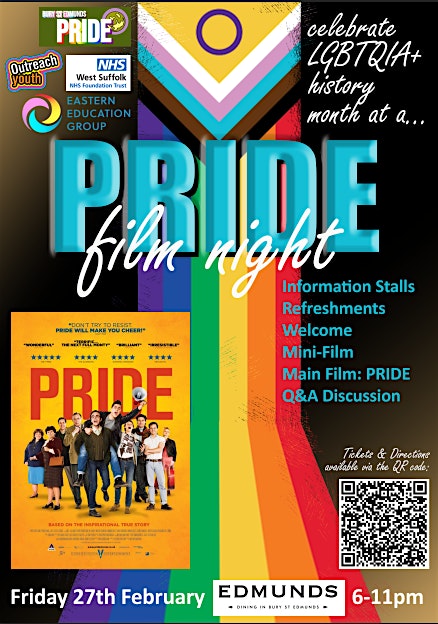
EEG Film Night – LGBTQIA+ History Month

- This event has passed.
EEG Film Night – LGBTQIA+ History Month
February 27 @ 18:00 – 23:00
Get ready for an inspiring and cinematic evening, celebrating LGBTQIA+ history month, through experiences and connection. All welcome.
We are excited to announce our EEG Pride Film Night, on Friday 27th February 2026 to celebrate and shine a spotlight on LGBTQIA+ History Month. Our event is completely Free, the theme of the night is allyship, which will be encouraged and promoted throughout the night. We will be supported by external partners including BSE Pride, Outreach Youth and West Suffolk Hospital.
The event will take the following format:
- Doors open from 6pm / Information stalls available
- Welcome & introduction
- Mini-film + speaker introduction
- Main Film (Pride)
- Q&A panel and audience discussion
Event Timings: Doors will open from 6pm, information stalls will be available. Film to begin at 7pm (promptly). Event to close at 11pm. The bar will be open and canapes will be provided.
For more detailed information on how to get to the Edmunds Restaurant, please see the map in the photo section.
Synopsis of Pride (2014)
Pride is a historical comedy-drama based on the true story of an unlikely alliance formed during the 1984 British miners’ strike. A group of gay and lesbian activists in London, led by Mark Ashton, recognise that miners and the LGBTQ+ community are both facing oppression. They form Lesbians and Gays Support the Miners (LGSM) and begin fundraising for mining families despite resistance from both sides.
Taking their support directly to the Welsh mining village of Onllwyn, the activists gradually break down prejudice through solidarity, generosity, and shared struggle. As friendships grow, both communities realise the power of unity in the face of discrimination. The story culminates in a moving display of mutual support during the following year’s Pride march, showing how compassion and courage can bridge even the widest divides.
LGBTQIA+ history in the UK
LGBTQIA+ history in the UK reflects centuries of shifting laws, attitudes, and activism, beginning with the Buggery Act of 1533, which introduced the death penalty for same-sex acts under Henry VIII. Although the death penalty was removed in 1861, same-sex acts still carried a minimum 10-year prison sentence, and by 1885, the Criminal Law Amendment Act made any homosexual act—public or private—prosecutable, even affectionate letters between men. Attempts to legislate against lesbianism emerged in 1921, but were rejected over fears that such laws would encourage women to explore homosexuality. A major turning point came with the 1957 Wolfenden Report, which argued that homosexuality was not a disease and should not be criminalised, paving the way for the Sexual Offences Act 1967, which partially decriminalised consensual same-sex acts in private between men over 21 in England and Wales, with Scotland and Northern Ireland following later. The UK’s LGBTQ+ rights movement gained momentum with the founding of the Gay Liberation Front in 1970 and the first UK Pride march in 1972, which began a new era of visibility and activism. Major 21st-century milestones include the Civil Partnership Act 2004, granting legal recognition to same-sex couples, the Gender Recognition Act 2004, enabling transgender people to be legally recognised in their gender, the legalisation of same-sex marriage in 2013, and the inclusion of LGBTQ+ content in school curricula from 2019 onwards, further strengthening equality and representation across the UK.LGBTQIA+ history in the UK reflects centuries of shifting laws, attitudes, and activism, beginning with the Buggery Act of 1533, which introduced the death penalty for same-sex acts under Henry VIII. Although the death penalty was removed in 1861, same-sex acts still carried a minimum 10-year prison sentence, and by 1885, the Criminal Law Amendment Act made any homosexual act—public or private—prosecutable, even affectionate letters between men. Attempts to legislate against lesbianism emerged in 1921, but were rejected over fears that such laws would encourage women to explore homosexuality. A major turning point came with the 1957 Wolfenden Report, which argued that homosexuality was not a disease and should not be criminalised, paving the way for the Sexual Offences Act 1967, which partially decriminalised consensual same-sex acts in private between men over 21 in England and Wales, with Scotland and Northern Ireland following later. The UK’s LGBTQ+ rights movement gained momentum with the founding of the Gay Liberation Front in 1970 and the first UK Pride march in 1972, which began a new era of visibility and activism. Major 21st-century milestones include the Civil Partnership Act 2004, granting legal recognition to same-sex couples, the Gender Recognition Act 2004, enabling transgender people to be legally recognised in their gender, the legalisation of same-sex marriage in 2013, and the inclusion of LGBTQ+ content in school curricula from 2019 onwards, further strengthening equality and representation across the UK.
Why is important to support the LGBTQIA+ community
Supporting the LGBTQIA+ community is essential in ensuring that everyone can live openly, safely, and with dignity. By standing against discrimination and affirming equal rights, we help reduce stigma and create environments where people feel valued and respected. This support has a profound impact on wellbeing, as acceptance is closely linked to better mental health and a stronger sense of belonging. Inclusive communities are healthier and more resilient, benefiting from the full contributions of all individuals. Ultimately, supporting the LGBTQIA+ community reinforces compassion, equality, and unity—values that strengthen society as a whole.
