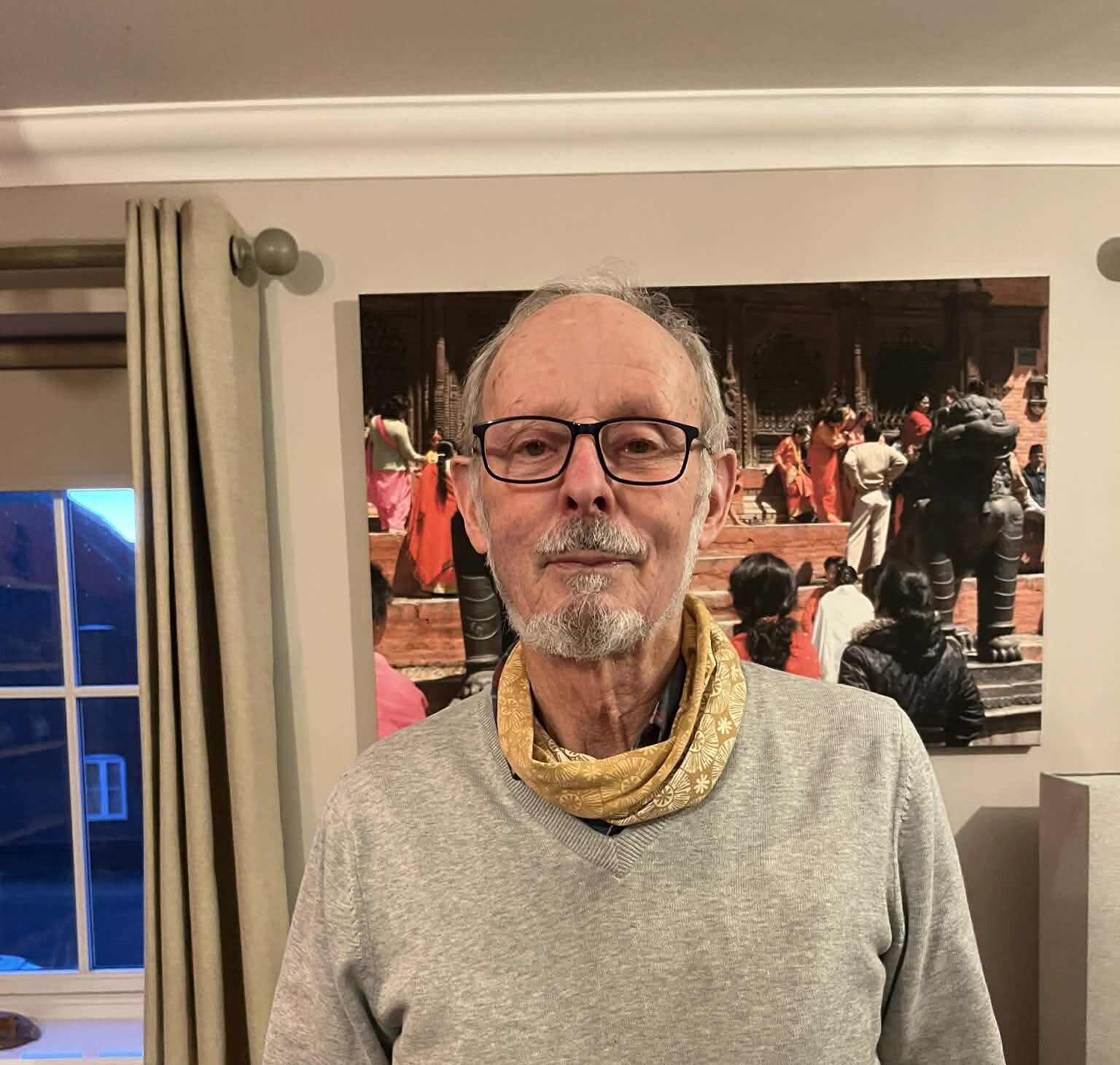
John joined West Suffolk College as a lecturer in 1965 and recalls the fascinating early beginning of the Art and Design department. He was the College’s first Applied Art and Design lecturer. Indeed, he remembers key individuals from the College’s history: Principal John Phillips (1958-1971), Principal Desmond Storey (1971-1985) and Principal John Shipston (1985-1995), Harvey Frost, Arthur Revett and John Norris, as well as the work done in the College’s Northgate Annexe. During his time here, the department of art grew and grew, eventually becoming a substantial department in its own right. John was the de facto Head of Art (Applied Art and Design) until his early retirement in 1995.
How did you come to join Eastern Education Group?
In early September 1965, I joined the staff at West Suffolk College of Further Education as a grade A lecturer. This meant that I would have 24 contact hours of teaching and instruction each week. My area of expertise was Applied Art and Design.
Each year the Principal, Mr. Phillips M.A., would welcome back the academic staff in his “gown” and, like him, we were expected to wear formal clothes – suits, because we were all male and it was the 1960s! This formal approach extended into the lecture rooms as well as workshops, so “white” duster coats hung behind each door. Yes, it was formal, but felt comfortable.
At that time the College was spread over two sites. The main building in Out Risbygate and the other at old girls’ county grammar school,110 Northgate Street, known as the Annexe. My post was in the General Studies department, and Lou Booth was the Head of Department. It probably began as the commercial and business section along with the well-established Engineering, Building and Electrical departments. Back then, in ‘65, there were full on-site facilities at both locations. Lunches were prepared and cooked in both locations and it was excellent. Before coming to the College, I had worked at Mildenhall Secondary school, so I appreciated the upgrade in provision.
Each site also had its own library, and while the Annex was much smaller, it properly reflected the scope of general studies at “O” and “A” in English, Economic History, Geography and Sociology. A few years later, I would add “A” levels in both Art and Art History to those same library shelves. In fact, the library did not just reflect the teaching work of the Annexe staff, but the staff themselves were also treated as a really valued resource – one to be both supported and encouraged.
That said, at the main building, Mr. Phillips did walk the corridors – yes, probably in his gown – to check on each of the different departments’ classes and workshops. So, he could appear at any time, dropping in to your group, ask questions, and check we were all suitably dressed. What’s strange is none of us thought anything of it, it was normal for that time!
When I first started, my timetable consisted of just 4 hours of what might be termed “art” based – that was with the day release hairdresser students. The remaining 20 contact hours were described as General or Liberal Studies.
I left school at 15, like most secondary school pupils. Untypically though, I gained a place at the Cambridge College of Technology’s Art School. Being such a young age, I needed to take 3 “O” levels and at least one “A” in the first year to progress onto higher courses.
Here at the College, we had good resources all round: a split campus and a varied timetable, at least for me. I delivered history of design in both engineering and building to full-time students, some of which I still know and who stop and speak to me, which is lovely. One, in the construction department went on to become head of it – Ben Mayhew! That’s proper progression for you. Everything felt possible back then.
Mr. Phillips left and was replaced by Desmond Storey in 1971. John Norris, who was Head of the Construction department, stepped in to fill this unexpected gap. By the time Desmond, started the Harvey Frost Hall was already built – which is over the chalk pits, which, as it happens, I played in as a boy. Being associated with the building students, I felt confident to approach the Site Agent in charge of this new building project, hoping he appreciated the extent of those historical chalk workings. He didn’t, and when work was completed, Erich, one of the senior electrical engineers, parked his car out front, which promptly dropped into a “sink” hole and all but disappeared during one evening class.
My timetable required working at both sites, creating natural gaps in contact hours. It felt free. Adding to this, the College also had its own minibus which could be booked for group visits. In fact, the whole atmosphere encouraged ‘thinking outside of the class/lecture room experience’. It was possible then to deliver ‘course content’ via the making of an instructional film which could be used to instruct others. I used this open and ‘interactive’ approach with a wide range of engineering and construction groups, as well as with my own Art and Design groups.
When the Principal changed from Desmond – who personally provided food and drinks at the end of each year as a “thank you” to his staff – to John Shipston in 1985, very new directions were already in the wind. These new opportunities, along with evolving educational demands (like C.P.V.E., Certificate in Pre-vocational Education) opened the way for further growth in Art and Design related studies for me and the College.
Working days were from 9.00am to 5.00pm, so two groups equaled 14 hours a week contact -half a contract. More staff would be required, and that’s when I recruited Penny Embrey to teach Graphic design. In fact, she later became Head of Department a couple of years after I retired.
While courses such as these created new employment and opportunities for promising students, educational demands rarely stand still, so I looked for new courses to run which could potentially replace those 14 hours; then along came BTEC. But, before that, I set up and ran a one-year course. I decided Fashion and Design would be a sensible direction.
This very new departure was delivered, like the C.P.V.E., at the Annexe. I knew which rooms were likely to be available and when to guarantee smooth delivery. It also enabled me to bring in a new part-time member of staff – someone with pattern making experience – to share delivery of this fashion course with myself.
The two original Departments of Engineering and Building were undergoing significant change, Motor Vehicle Studies in particular. I was in a position to read other department’s room timetables, since I was on the Academic board. I took advantage of this to scan the use of facilities at the main building. I had been voted onto the Board by our then Union Rep., Richard (Dick) Screwby.
He could see changes coming within his own department (Engineering), which needed a steady and confident hand. As it happens, Mr. Revett, the Head of Engineering, was my father-in-law; probably why Dick thought I could manage him?! It was while addressing Dick’s concerns that I could also see exactly where I could bring all the Art and Design work into the main building (from the Annexe), into those Motor Vehicle workshops.
We soon occupied the hoist workshop with its roller steel doors, and soon we had “life” classes, easels, donkeys, photographic darkroom and individual studio spaces for the more advanced personal developments that BTEC would bring.
As the governance of the College changed from county council to one where bidding for funding replaced government allocation linked to pre-determined policies, interdepartmental competition encouraged a kind of ‘internal’ competition; one of the probably unintended consequences of this was that much of the earlier convivial banter between departmental staff largely disappeared. So did the Staff Association which had existed at the College since I had joined. Strangely, the needs for art and design did buck this trend.
Perversely, I then needed to use several of the Engineering staff to deliver modules in computer aided design and fabricating with metal, so the Engineering Department didn’t lose out altogether! In fact, it was probably through them that I was able to update and much improve the kind of Art education I had back at Cambridge School of Art in the 1950s.
I should say at this stage that much of the support that the fast-developing Art and Design groups received was likely to be because I had always been far more socially – as well as professionally – involved with the well-established departments. I should also say that I had maintained an interdisciplinary professional practice outside of the College, so I was a regular visitor to other departments.
Interactive Science projects that focus on Visual Perception was my area of interest: I designed and presented ‘plores’ for Bristol and London’s Science and Industry Museums. I continued this after I left the College.
By the time I retired, we ran 4 full-time groups (2 “A” level’s: Art and History of Art) and serviced 4 other courses within other departments. Shortly after, Martin Vella took over. Martin would go on to provide the pre-University course “Foundation Studies in Art and Design” and I think that is pretty much where it is today. After he left, as I said earlier, Penny Embrey took over followed by Derek, who brings us to today I believe.
What are your memories of Harvey Frost (our co-founder)?
I first came across Harvey Frost when building work was outside where Pizza Express is now on Abbeygate Street – the company there was called Ridley’s Gentleman Outfitters. I had parked my car there and came back to find a large dent and brick dust on the roof. I spoke to the workman, who seemed indifferent to the danger of falling masonry, so I asked for the name of his boss, which was Harvey Frost.
Therefore, I went to his yard on Out Westgate Street and spoke with him. He asked what I think he should do about this issue. I said his staff’s work practices were a concern and suggested that maybe the local college was a good place for them to go to get some basic training. The meeting came to an end on good terms, and he paid for a new expensive Ashley roof for my car. I was pleased with the outcome.
Then, later on, I had an interview with Mr. Phillips for the post of Lecturer in Applied Art and Design at the College, Then, Mr. Frost came in and was introduced by Mr. Phillips as the Chairman! Mr. Frost shook my hand and said, “we’ve met, haven’t we.” Harvey Frost was personable and a gentleman in the old sense – an effortless leader.
What are your memories of Principal Desmond Storey?
I remember him as a gentleman, and he kindly paid for thank-you drinks (alcoholic) and nibbles out of his own funds, creating a convivial atmosphere when the staff left for our summer break each year.
What your memories of the Technical Institute?
As a schoolboy, I remember the Technical Institute building, on the site of the Silver Jubilee School. It had two classrooms – engineering in one, and woodwork in the other. Archie Candler was Head of Science at that school and taught me – he may have been the one that told me about it. I have since discovered he later worked at the College.
What are your memories of John Norris (the first full-time member of staff).
I recall him as a very nice man: affable, straightforward, and helpful. He was the deputy principal and became temporary principal when Mr. Phillips unexpectedly left his post rapidly over the summer. John was Head of Building and Construction.
Are there any family members who have connections to EEG?
My wife is the daughter of Mr. Arthur Revett – who was the second full-time member of staff the College employed. Arthur was Head of Engineering and a strong character.
What did you go onto to do after the College?
I left a few months later retiring early; I was 54 years old. I went on to write and deliver drop-in workshops for London’s Museum of Science and Industry. At the time, I was an active member of the British Association for the Advancement of Science and a member of the European Convention on Visual Perception, and a founding member of the The British Interactive. I am also a volunteer wood carver of standing trees across West Suffolk.
Lastly, do you have any advice for future students and staff at EEG?
For me the College was like a garden: collect the right seeds at the right time, plant them in good soil, be patient, and they will bloom! An opportunity for local pupils and students now that grants and awards are a thing of the past.